| Plan
Gold: Publisher’s Preview
By Mike Bennighof, Ph.D.
November 2017
A long time ago, someone here had the idea that we needed more games based on alternate history. We had a few in print at the time based on the U.S. Navy’s plans to go to war with assorted enemies, allies and neutrals. As ideas went, it wasn’t a bad idea, just one with little planning or strategic thinking behind it.
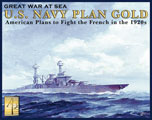 Great War at Sea: U.S. Navy Plan Gold is based on the U.S. Navy’s Plan Gold – the very rudimentary plan for a potential naval war against France. The game followed up a number of other “Plan” games we had in print at the time: Plan Orange (naval war with Japan), Plan Black (naval war with Germany) and Plan Red (naval war with Britain). Only Plan Red is still around. Great War at Sea: U.S. Navy Plan Gold is based on the U.S. Navy’s Plan Gold – the very rudimentary plan for a potential naval war against France. The game followed up a number of other “Plan” games we had in print at the time: Plan Orange (naval war with Japan), Plan Black (naval war with Germany) and Plan Red (naval war with Britain). Only Plan Red is still around.
All of the games were based on actual war plans; some of these plans were pretty detailed (Plan Orange) and some just outlines not far removed from the cocktail-napkin stage (Plan Gold). The sketchy nature of Plan Gold allowed me to invent the situation and the scenarios; I really should have ginned up a detailed fictional background (the “story arc” both preached and practiced among role-playing publishers) and provided a whole lot more scenarios set against the background.
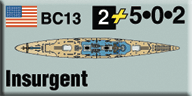 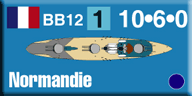
U.S. Navy Plan Gold has twenty scenarios: six battle scenarios and fourteen operational scenarios. They’re pretty good for what they are, but lack a connective narrative to put them in context (and there are a few with no connection to the others). Plan Gold was the game that introduced ground combat to Great War at Sea, with a simple system of troop points for both invaders and defenders.
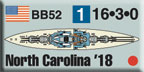 Since I expected the audience for the game to be hard-core Great War at Sea players, to keep their attention I wanted most of the ships to be vessels that had not appeared in other Great War at Sea games. That makes for an unusual mix of ships. Since I expected the audience for the game to be hard-core Great War at Sea players, to keep their attention I wanted most of the ships to be vessels that had not appeared in other Great War at Sea games. That makes for an unusual mix of ships.
Like all
the major powers, France had plans for powerful
battleships that were never completed. The Normandie class and Lyons class are included, along with a number of
prizes from the First World War. The former
Austrian dreadnought Prinz Eugen, transferred
to French control in August 1920, was expended
as a gunnery target in June 1922. Here we
provide her in French colors, as Corse. The French also received the German Thüringen in April 1920 and used her as a target
before scrapping her in 1923. Neither ship
would have gone to the breakers during a renewed
war, and so she’s in the game as well,
as Alsace.
In 1914, Greece ordered a Provence-class
battleship named Basileus Konstantinos, a ship included in our Dreadnoughts supplement. She had not been formally laid
down when the First World War erupted but
material had been gathered and the French
navy considered completing her as Savoie.
But we used that name in the Dreadnoughts book for another ship; in Plan Gold she bears the name Vendée.
 The
French fleet lacked sufficient cruisers for
scouting; we included the 1914 light cruiser
design and the 1922 design in Plan Gold. There are also four former German cruisers
and one ex-Austrian, all in French colors.
These ships did serve France in the 1920s
and 1930s. And as we’ve covered elsewhere,
the French order of battle includes their
unusual combat
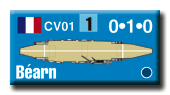
cruiser design, plus the aircraft carrier Béarn and their projected battle
cruisers. The
French fleet lacked sufficient cruisers for
scouting; we included the 1914 light cruiser
design and the 1922 design in Plan Gold. There are also four former German cruisers
and one ex-Austrian, all in French colors.
These ships did serve France in the 1920s
and 1930s. And as we’ve covered elsewhere,
the French order of battle includes their
unusual combat
cruiser design, plus the aircraft carrier Béarn and their projected battle
cruisers.
The United States has its own sets of big
ships it planned but never completed. There
are four of the huge South
Dakota class as shown on the game’s
cover, two with 16-inch guns and two with
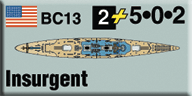
18-inch guns. I became intrigued by the Navy’s
multiple plans for new cruisers, and included
several variants of the Omaha class: the better-designed four-turret version,
the version with 14-inch guns, and the light
aircraft carrier design project that became
the basis for the World War II Independence-class
converted light cruisers.
 Probably the game’s best feature, from a designer’s viewpoint (and likely from a player’s as well) is the map. The Caribbean has not seen serious military conflict since 1898, even though many battles took place there in the preceding centuries. It’s a large basin that fits exactly on the 34x22-inch map without altering the standard Great War at Sea scale, which is pretty cool. On the left edge is the Panama Canal, on the right are the islands of the Lesser Antilles, at the top is the southern tip of Florida and the bottom is fringed by the northern coast of Venezuela and Colombia. The operational area is neatly framed by land. Probably the game’s best feature, from a designer’s viewpoint (and likely from a player’s as well) is the map. The Caribbean has not seen serious military conflict since 1898, even though many battles took place there in the preceding centuries. It’s a large basin that fits exactly on the 34x22-inch map without altering the standard Great War at Sea scale, which is pretty cool. On the left edge is the Panama Canal, on the right are the islands of the Lesser Antilles, at the top is the southern tip of Florida and the bottom is fringed by the northern coast of Venezuela and Colombia. The operational area is neatly framed by land.
Sitting in a truly dominant position is the American naval base at Guantanamo Bay; just one play of an operational scenario will make it crystal clear why Theodore Roosevelt – following the advice of Alfred Thayer Mahan - insisted on taking it in 1901. Fleets based in Guantanamo sit astride the lines of communication to and from the Panama Canal, and also within striking distance of the north-south passages between the big islands of the Greater Antilles. The Canal is the big prize, one vital to American economic interests that will be defended at all costs. The French are usually based at Martinique, which is not a bad location – just not as dominant as Guantanamo.
U.S. Navy Plan Gold originally began as a “Classic Wargame,” our poorly-conceived attempt to sell games based on unusual topics to a small hard-core audience. That by itself isn’t a bad idea, but when we launched U.S. Navy Plan Gold we lacked the ability to print games on demand in small quantities, as we can now. With that capability, Plan Gold would have been enormously successful; since we had to make a lot of them, there are still copies on hand. We won’t be reprinting U.S. Navy Plan Gold once those run out.
Click here to order U.S. Navy Plan Gold NOW!
Mike Bennighof is president of Avalanche Press and holds a doctorate in history from Emory University. A Fulbright Scholar and award-winning journalist, he has published over 100 books, games and articles on historical subjects.
He lives in Birmingham, Alabama with his wife, three children and his dog, Leopold.
|